
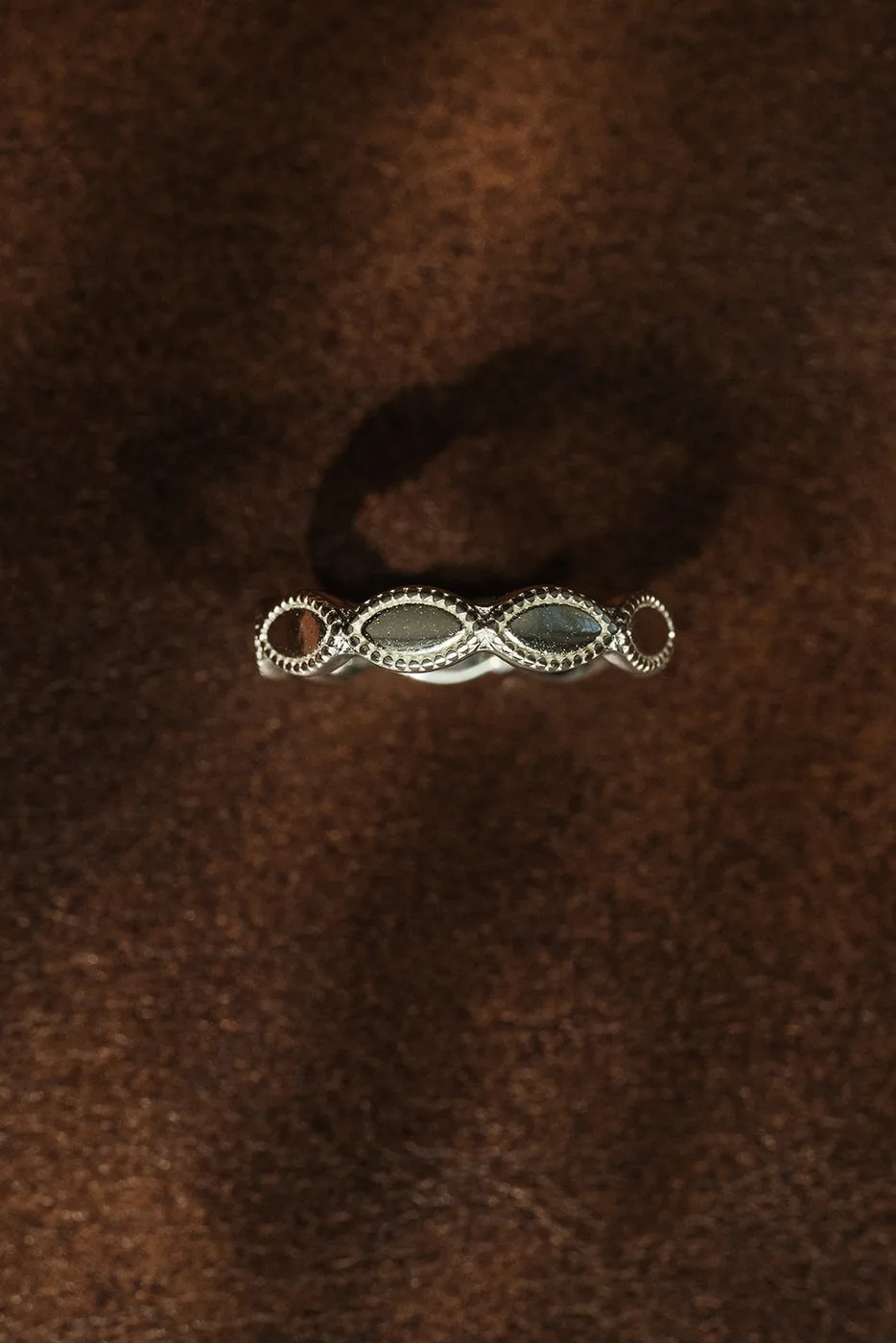
Choosing jewelry for sensitive skin requires more than finding a label that says “gentle” or “hypoallergenic.” A piece touches your body through its metal surfaces, coatings, closures, and sometimes adhesives or decorative elements. Comfort also depends on fit, moisture, friction, and your own history of reactions. Before committing to a design, ask what every skin-contact component contains and how the piece should be maintained. Clear answers cannot guarantee that you will tolerate it, but they can help you avoid an uninformed choice.
Start with the materials, not the reassuring label
The first question about jewelry for sensitive skin is simple: “What are the materials in every part that touches me?” Ask separately about the main body, chain, clasp, earring post, backing, jump rings, and soldered joins. A description may refer only to the decorative face or visible finish. For example, a pendant described as gold may hang from a chain with a different composition. If a component is unspecified, treat that as an unanswered question rather than assuming it matches the rest.
When comparing jewelry for sensitive skin, distinguish a metal’s identity from its purity or alloy composition. Solid gold is not necessarily pure gold; karat gold contains other metals. Those additions can differ between alloys, including alloys of the same karat. Sterling silver is at least 925/1000 silver, with other metals making up the balance. Neither “gold” nor “sterling” establishes that a particular wearer will be comfortable. If you have a known sensitivity, ask about that substance explicitly rather than relying on the precious-metal name.
Descriptions of jewelry for sensitive skin also need careful reading when a surface layer is involved. Gold-plated, gold-filled, and solid gold are not interchangeable descriptions. Gold-filled is not solid gold, and a gold-colored appearance does not establish either construction. Under U.S. guidance, vermeil descriptions have specific FTC conditions concerning the sterling-silver base and gold layer. Ask which description applies, what lies underneath, and what information is available about the coating. Do not infer those details from a photograph or an attractive product name.
A useful discussion about jewelry for sensitive skin separates documented details from broad marketing language. “Hypoallergenic” is not a promise that no wearer will react, while “nickel-free” should prompt a question about exactly which components that statement covers. Stainless steel and titanium descriptions also benefit from precise material identification rather than a generic label. A hallmark can be one clue, but it is not standalone proof of authenticity or complete alloy composition. Request the available material documentation and note any limits in the answer.
- Ask: Does the material description cover all skin-contact parts?
- Clarify: Is the stated finish a coating, a bonded layer, or the underlying metal?
- Record: Which details are confirmed, and which remain unknown?
Inspect contact points and the way the piece fits
Evaluating jewelry for sensitive skin means looking beyond the largest visible component. Earrings are a good example: the decorative front may be one material, while the post and backing are another. A butterfly backing can also collect residue around its folds. Ask whether the post, backing, and any attached fittings are individually identified. If you already know that a particular component causes trouble for you, do not assume a different decorative front makes the whole earring a suitable alternative.
Fit is another decision criterion for jewelry for sensitive skin because pressure and repeated rubbing can cause discomfort independently of a metal sensitivity. A snug ring may hold moisture beneath it; a loose bracelet may slide repeatedly across the same area. A necklace clasp can rest against the back of the neck for hours. As an example, someone bothered by rubbing at the neckline might prefer to assess chain texture and clasp position before comparing pendant shapes. More expensive materials do not correct an unsuitable fit.
For everyday jewelry for sensitive skin, consider the actual wearing conditions rather than an idealized photograph. Will the piece sit under gloves, tight sleeves, a watch strap, or a work uniform? Will soap, lotion, or perspiration become trapped beneath it? Broad bands create different contact conditions from narrow ones, while open designs may have edges that need inspection. The everyday jewelry showcase can help you identify styles to discuss, but ask D LOVE JEWELRY to confirm the construction and dimensions of any specific piece.
Before selecting jewelry for sensitive skin, describe your intended use with concrete details: occasional evening wear, desk work, or a necklace worn over clothing rather than directly against skin. This gives a consultation a more useful starting point than simply asking for the “safest” option. Consider practical tradeoffs too. A lighter piece may feel less cumbersome but still have an uncomfortable closure; a smooth design may be easier to wipe yet unsuitable for your preferred fit. No single feature settles the whole decision.
A small inspection checklist
- Look for rough edges, uneven seams, and fittings that press into skin.
- Check whether the closure can be handled without scraping or pinching.
- Ask for measurements rather than judging scale from photographs.
- Identify surfaces that will remain in prolonged contact with your body.
Ask what happens when finishes wear and care gets complicated
A coating can affect the initial contact surface of jewelry for sensitive skin, but it should not be treated as a permanent barrier. Wear varies with construction, friction, cleaning, and use. When a finish thins, the underlying material may become exposed. Ask what the base metal is even if the piece looks fully covered, and whether any maintenance information is available. If your decision depends on avoiding contact with that base, uncertainty about the coating’s condition is a meaningful limitation.
Care requirements matter when choosing jewelry for sensitive skin because an unsuitable routine can damage a piece or leave residue against the body. Ask for instructions covering the complete item, not just its principal metal. A method suitable for a plain metal chain may be inappropriate for pearls, delicate gems, glued components, or organic and resin-based elements. Chemicals, fragrance, chlorine, heat, and unsuitable ultrasonic cleaning can harm some jewelry. The GIA jewelry-care guidance offers general context, but piece-specific instructions still matter.
Do not try to make jewelry for sensitive skin by applying an improvised sealant or repeatedly using harsh cleaners. Such changes may alter the finish, affect decorative components, or introduce another substance into contact with your skin. Instead, ask whether the proposed cleaning method is compatible with every material present. For example, a pearl-accented earring and a plain metal hoop may require different care even when their posts share the same material description. “Clean thoroughly” is not a sufficiently precise instruction for either.
For keepsake jewelry for sensitive skin, ask about the skin-contact setting separately from the enclosed or decorative keepsake material. You can use the cremation keepsake information or breast-milk keepsake information to frame a gentle consultation without assuming any current process or service. Before sending personal material, obtain written instructions and applicable local information. Confirm handling and care details directly with D LOVE JEWELRY. There is no need to rush a meaningful decision, and a keepsake need not be worn continuously to remain significant.
Turn the answers into a practical decision
The strongest comparison of jewelry for sensitive skin is between specific pieces with specific answers. Write down the material of each contact component, the type of finish, the dimensions, and the care restrictions. Then mark gaps rather than filling them with assumptions. For example, one design may have a clearly identified post but an unspecified backing, while another provides complete component information but has a fit you dislike. Neither should automatically win simply because its description sounds more reassuring.
When asking D LOVE JEWELRY about jewelry for sensitive skin, use the email consultation contact page to send a focused set of questions. Identify the design you mean and explain any known material concerns without expecting an allergy guarantee. Ask the brand to confirm current details, including whether further component information or measurements can be provided. The site is a showcase and consultation resource; do not assume that a displayed design establishes current availability, purchase arrangements, adjustment options, or return terms.
Your previous experience can guide questions about jewelry for sensitive skin, but it cannot establish the cause of a new reaction. Keep a simple record of the item, wearing duration, contact area, and products used nearby if discomfort occurs. Stop wearing a piece that irritates you rather than repeatedly testing whether you can tolerate it. Persistent or concerning symptoms deserve advice from a qualified clinician; suspected contact allergy may require professional assessment. Jewelry descriptions and home wear experiments are not substitutes for a diagnosis.
A sensible final choice of jewelry for sensitive skin balances material clarity, comfortable construction, manageable care, and your tolerance for uncertainty. If a crucial contact component remains unidentified, pausing is reasonable. If information is clear but the fit or upkeep does not suit your routine, another design may be more practical. You do not need to choose the most elaborate option or accept a reassuring label at face value. The aim is a well-informed decision, with realistic expectations and room to stop wearing a piece if it causes discomfort.