
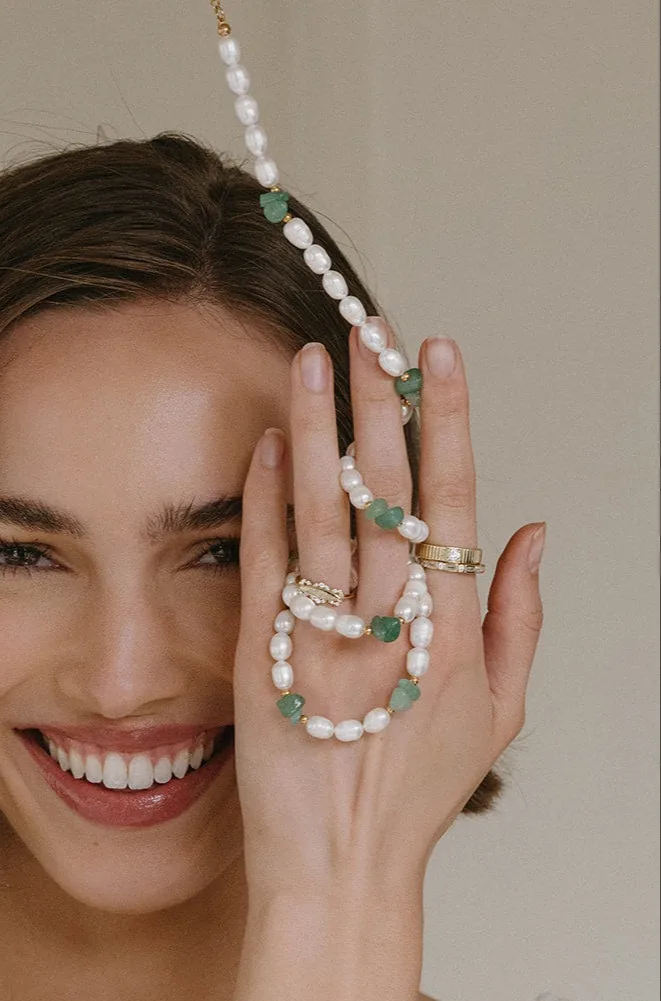
Miami jewelry style is most useful when it responds to the way you actually live: bright afternoons, air-conditioned interiors, outdoor dinners, and clothes that often leave the neckline or wrist exposed. Warm light can make polished metal look especially luminous, but elegance does not require a large collection or constant sparkle. A small number of well-chosen pieces can create a recognizable rhythm, whether your day involves a linen shirt, a tailored dress, or a simple cotton tee.
Rather than treating Miami jewelry style as a fixed dress code, think of it as a balance between visibility and ease. Choose one feature to lead, then let the other pieces support it. A broad cuff might need only small earrings; expressive earrings might work best with an open neckline. The goal is not to imitate an imagined city uniform, but to make jewelry feel deliberate in strong light, changing settings, and the practical conditions of warm-weather wear.
Choose color for your wardrobe, not just the sunshine
Metal color is a useful starting point for Miami jewelry style because it changes the relationship between jewelry and clothing. Yellow gold tones can create a warm continuation of cream, sand, rust, and olive. Silver-colored metals often provide a cooler contrast against white, navy, charcoal, or saturated blue. These are visual options, not rules about skin tone. Compare pieces beside the clothes you wear most, ideally in daylight and ordinary indoor light, before deciding which finish feels most versatile.
Surface finish matters as much as color in Miami jewelry style. A mirror-polished chain can flash with movement, while a brushed surface gives a quieter impression. If your wardrobe already includes glossy sandals, metallic hardware, or vivid prints, a softer finish may feel more balanced. Conversely, a plain matte outfit can benefit from a single reflective detail. Expect polished surfaces to reveal fingerprints and fine wear marks; choosing them means accepting some maintenance rather than expecting a permanently untouched appearance.
When exploring Miami jewelry style, separate a piece's appearance from its material description. Gold-colored does not necessarily mean solid gold, and gold-filled is not the same as solid gold. Sterling silver contains at least 925 parts silver per thousand. Vermeil descriptions have specific U.S. FTC requirements concerning the silver base, gold fineness, and coating thickness. A stamp can be informative, but it is not independent proof of authenticity. Ask for a clear written material description whenever the distinction affects your choice.
A restrained mixed-metal approach can also suit Miami jewelry style, especially if you already wear a watch or meaningful ring in a different tone. Repeat one tone twice so the combination looks intentional: for example, silver-colored earrings and a watch beside a yellow-toned pendant. The repetition supplies coherence without requiring everything to match. Use the collection showcase to compare visual directions, then ask D LOVE JEWELRY to confirm current material details rather than inferring composition from photographs.
Let proportion and movement guide everyday combinations
The everyday side of Miami jewelry style depends on scale. Jewelry that looks balanced in a close-up photograph may feel oversized beside a narrow neckline or disappear against a patterned blouse. Check the whole outfit in a mirror, not just the piece itself. As an example, medium hoops can frame the face without competing with a shirt collar, while a compact pendant can add focus to a plain tank. Neither combination needs additional layers simply to look finished.
Comfort gives Miami jewelry style its staying power. Consider how earrings feel after several hours, whether a bracelet knocks against a desk, and whether a ring catches on pockets or bag linings. Large pieces can be visually light yet physically cumbersome; small pieces can still snag if their settings project outward. When comparing designs, ask about dimensions, weight, fastening, and setting construction. Photographs are helpful for shape, but they cannot establish how a piece will behave during your particular routine.
Layering works best in Miami jewelry style when each piece has a distinct role. Start with one necklace that sits where you want the eye to land, then add another only if it creates useful spacing. Similar lengths can overlap or tangle, particularly during movement. Different chain textures may help distinguish the layers, but they do not guarantee freedom from tangling. Test the combination while sitting, walking, and leaning forward; a look that works only when you stand still is not truly effortless.
- With an open linen collar, try one pendant that remains visible without resting awkwardly on the fabric edge.
- With a high neckline, consider earrings as the focal point instead of adding several necklaces.
- For desk work, compare a close-fitting bracelet with a loose style that may contact the keyboard.
- For an evening print, repeat one color or shape rather than competing with every detail.
A useful test for Miami jewelry style is whether you would reach for the combination on an ordinary morning. If arranging it takes repeated adjustments, simplify it. Keep one easy pairing for casual clothes and another for more structured outfits, then change only the focal piece when needed. The everyday jewelry showcase can help you identify silhouettes to discuss, but treat any example as a starting point for consultation, not confirmation of current availability or suitability.
Plan for coastal conditions without overpromising durability
Coastal life adds practical limits to Miami jewelry style. Sweat, sunscreen, fragrance, sand, and salt water create different exposures, and not every material tolerates them equally. A beach-inspired appearance does not make a piece appropriate for swimming. Before the beach, pool, or strenuous exercise, removing jewelry is often the more cautious choice. Store it securely away from loose sand and direct heat, and follow material-specific guidance rather than assuming that metal, gemstones, pearls, and composite pieces share one care routine.
For Miami jewelry style to remain easy, make getting dressed part of the care plan. Apply fragrance, lotions, and sunscreen before putting jewelry on, and allow products to settle. This reduces direct application onto the piece, but it does not eliminate later contact. Chlorine and other chemicals can harm some jewelry, and delicate gems, pearls, organic materials, or resin-based pieces may require particular caution. If the composition is unclear, ask before wearing the piece into an environment that could expose it to chemicals.
Cleaning decisions are another place where Miami jewelry style benefits from restraint. Do not assume an ultrasonic cleaner, steam treatment, soaking, or household cleaner is safe for every piece. Gem treatments, adhesives, coatings, and delicate settings can change the answer. A soft cloth may be suitable for some surfaces, but even simple care should follow confirmed instructions. The GIA jewelry care guidance offers a useful general reference; it does not replace advice specific to an individual piece.
Build Miami jewelry style around realistic care habits rather than hoped-for toughness. If you frequently move between errands and waterfront activities, choose a routine that includes a secure place to put jewelry before exposure. Keep pieces separated to reduce contact and potential scratching, particularly during travel. Ask D LOVE JEWELRY to clarify the materials and appropriate care for any design you are considering. No photograph can establish resistance to water, heat, chemicals, or repeated wear, and no general style recommendation should imply those guarantees.
Build a personal edit that works beyond one occasion
The most convincing Miami jewelry style usually has a personal anchor: a familiar shape, a preferred metal tone, or a piece with meaning. Begin there rather than assembling a complete look at once. As an example, someone who wears a cherished ring daily might choose quieter earrings and a necklace that echoes its rounded lines. Another person might prefer geometric earrings as a signature. Consistency can come from shape and proportion, not necessarily matching sets or identical materials.
Meaningful keepsakes can belong within Miami jewelry style without becoming its visual centerpiece. A cremation or breast-milk keepsake may be worn privately, occasionally, or not at all; there is no obligation to display its significance. If these possibilities interest you, the cremation keepsake information offers a place to begin considering questions. Before sending any material, obtain written instructions and applicable local information, and confirm current details with D LOVE JEWELRY. Do not assume preparation requirements or handling arrangements from a general article.
A focused consultation makes Miami jewelry style easier to translate into actual decisions. Share your typical necklines, preferred dimensions, existing pieces, and tolerance for maintenance. Explain whether you want jewelry for daily wear, occasional dinners, or a specific event, because those uses may call for different compromises. Through the email consultation contact page, ask D LOVE JEWELRY to confirm current design details and any relevant options. The site is a showcase and consultation resource, so imagery alone should not be treated as a purchase promise.
Ultimately, Miami jewelry style works when light, proportion, and personal meaning reinforce one another. Choose a finish that complements your wardrobe, keep movement and comfort in view, and respect the limits of each material. An everyday edit might be no more than earrings, one pendant, and a ring you already love. Leave room to remove a piece, change a layer, or wear nothing for a particular activity. Elegance comes from those considered choices, not from making every moment look dressed up.