
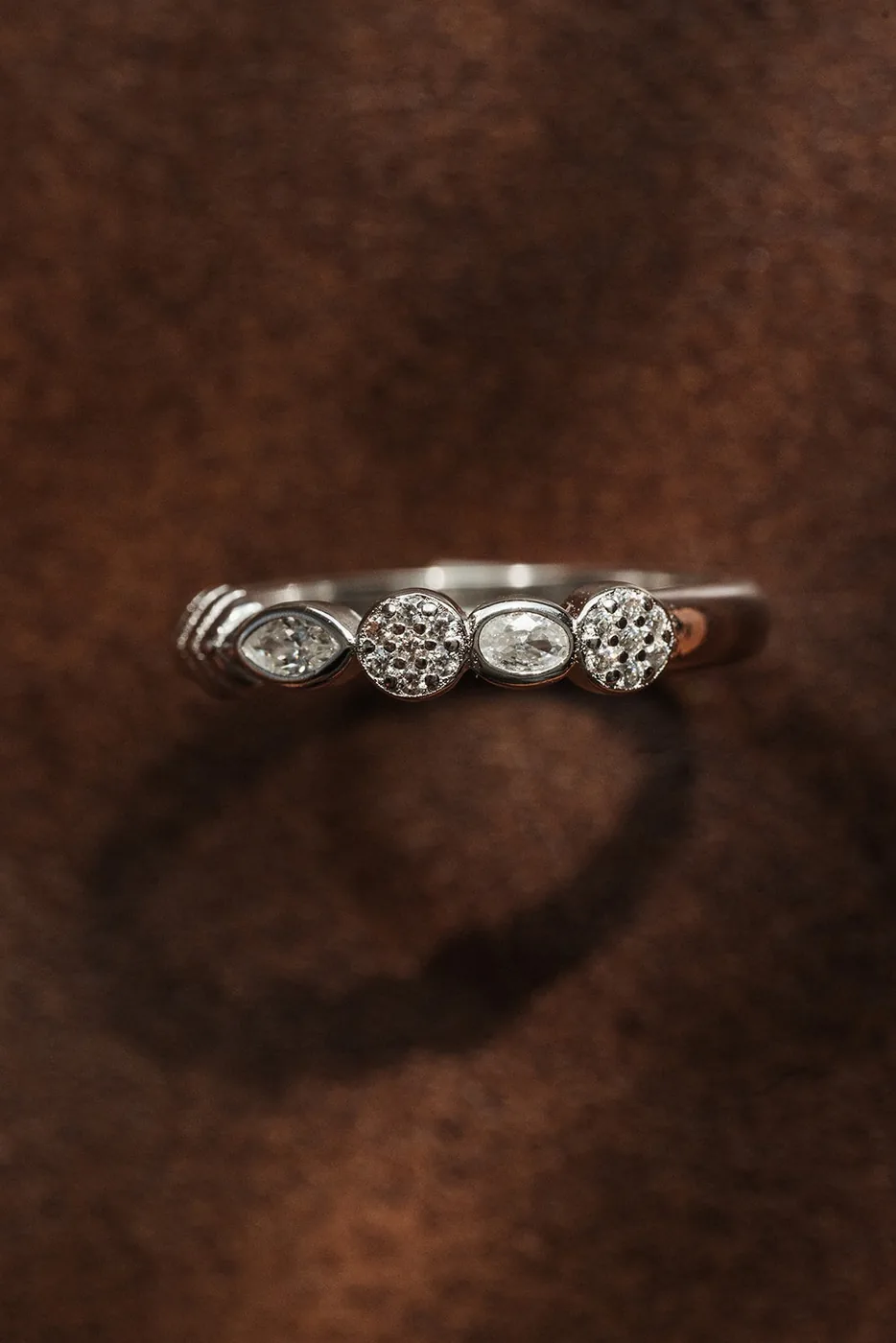
The best stacking rings look intentional without making your hand feel crowded. That balance comes from the combined width of the bands, their edge shapes, the height of any settings, and how freely your finger bends. A combination that looks balanced on a flat hand may behave differently when you grip a mug, type, or carry a bag. Start with comfort and contact points, then refine the visual rhythm.
Choosing stacking rings is easier when you treat the group as one wearable object rather than several separate purchases. Each ring changes how its neighbors sit and how much space remains below the knuckle. This guide explains how to assess those relationships, build a useful starting arrangement, and recognize when a simpler combination will serve you better.
Start with the space your finger actually offers
Before choosing stacking rings, look at the usable area between the base of your finger and its first bending joint. Keep your hand relaxed rather than stretching it flat. Shorter finger segments often suit a narrower total stack, while longer segments may accommodate more width. These are proportions, not rules: a broad statement band can work beautifully if it leaves enough room for comfortable movement.
The total width of stacking rings matters more than the number of pieces. For example, three 2 mm bands create roughly 6 mm of coverage before allowing for gaps or raised details; two 4 mm bands occupy more space. Wider combinations can feel tighter than a single narrow ring in the same stated size because they contact more skin. Do not assume every component should automatically share one size.
Try stacking rings at more than one point during an ordinary day, since finger size can fluctuate with temperature and activity. A sensible fit should feel secure without persistent pressure, and removal should not require painful force. If a combination leaves you struggling to bend your finger, take pieces off. If swelling, pain, or a trapped ring occurs, seek appropriate assistance rather than continuing a wear test.
For stacking rings, a rounded inner edge may make sliding and bending feel smoother, but a comfort-fit label alone does not settle the question. Interior curvature, band width, and your finger shape all influence fit. Ask for the actual dimensions and try comparable widths where possible. A narrow ring that spins may become steadier beside another band, but that does not mean it was correctly sized on its own.
A useful first fitting sequence
- Wear the anchor ring alone and notice where it naturally rests.
- Add one band, then make a loose fist and straighten your hand.
- Check whether either edge presses against a joint or neighboring finger.
- Try ordinary movements such as typing and holding a cup.
- Remove one piece if the combination feels restrictive rather than assuming you will get used to it.
A brief fitting is only a starting point. Notice comfort during normal wear, without testing jewelry through strenuous activity. For visual inspiration, the everyday jewelry overview can help you think about the role a stack should play in your routine. Confirm dimensions and current details directly with D LOVE JEWELRY rather than judging fit from photographs alone.
Match profiles before matching decoration
When arranging stacking rings, inspect them from the side as carefully as from above. A straight band may sit flush against another straight band, yet meet a raised stone setting only at one small point. That contact can leave a gap, tip the band, or place pressure on a delicate detail. A visible gap is not automatically a flaw; sometimes it is the most comfortable and least intrusive arrangement.
Contoured stacking rings can follow the outline of a center setting, but the curve needs to suit that particular shape. A shallow curve may accommodate a low oval setting, while a deeper notch may be necessary around a broader basket. Too much contour can leave the pieces looking disconnected when worn apart. Consider whether you want a fixed-looking pair or bands that remain visually useful on their own.
Setting height affects how stacking rings behave under sleeves and around everyday objects. A taller setting may give adjacent bands clearance, but it can also catch more easily. A lower setting may feel unobtrusive yet prevent a straight band from sitting close. Bezels, prongs, and decorative galleries each create different contact surfaces; no setting style guarantees snag-free wear or compatibility with every neighboring ring.
Spacers can help stacking rings by separating a stone-set band from another setting, though they are not universal protection. The spacer itself may rub, and an extremely thin band may not hold the desired distance consistently. Look for actual clearance around stones and prongs, not merely an extra ring between them. If the pieces repeatedly collide or catch, ask whether they should be worn separately.
Three shape combinations to compare
- Two low, plain bands: a straightforward starting point, provided their edges meet without pinching.
- A raised center ring with a straight band: potentially clean-looking, but check the side view for clearance beneath the setting.
- A center ring with a curved companion: useful for following an outline, with the tradeoff that the companion may look less balanced alone.
These are examples of design relationships, not descriptions of D LOVE products. Browse the collection showcase to identify silhouettes you like, then ask about profiles, measurements, and intended pairings. Photographs can suggest a shape, but perspective and lighting can conceal a narrow gap or exaggerate the height of a setting.
Create balance without adding unnecessary bulk
A clear focal point makes stacking rings easier to organize. Choose one feature to lead: a central stone, a broad polished band, or a distinctive contour. Let the other pieces support it with quieter surfaces or smaller proportions. If every ring has a prominent raised detail, the stack may look busy and feel crowded even when its measured width seems manageable.
To give stacking rings a deliberate rhythm, vary one element at a time. You might pair a smooth medium-width band with two narrower textured bands, or keep widths similar while changing metal color. As an example, a 3 mm plain band beside a 1.5 mm patterned band creates contrast without needing a third piece. Adding more is an option, not a measure of success.
Mixed-metal stacking rings need attention to wear as well as color. Different materials and finishes can respond differently to repeated contact, and softer surfaces may show marks sooner. Matching metal colors does not eliminate friction, either. Ask about the stated metal, any plating, the setting construction, and likely maintenance needs before committing to a combination intended for frequent wear.
Meaningful stacking rings can also combine an everyday band with a personal keepsake, but compatibility should come before a close fit. Organic or resin-based elements may need particular protection from abrasion, heat, and chemicals. If exploring the cremation keepsake information, ask for written material and care details. There is no need to make a sentimental piece part of a daily stack if separate wear feels more appropriate.
Material terms deserve careful reading. Gold-filled is not solid gold. Sterling silver contains at least 925 parts per thousand silver, while vermeil descriptions have specific U.S. FTC conditions concerning the base metal and gold layer. A stamp can be useful information, but it is not proof of authenticity. Ask D LOVE JEWELRY to confirm current material descriptions and any relevant documentation for a piece under consideration.
Balance across the whole hand matters, too. One substantial stack may feel better than several smaller groups pressing between adjacent fingers. Check the sides of your fingers with your hand relaxed. If neighboring rings knock together, try moving one to the other hand, reducing a band, or choosing a lower-profile arrangement rather than continually repositioning the pieces.
Keep the arrangement comfortable over time
Even well-chosen stacking rings need occasional reassessment. Look for new scratches at contact points, a band that has begun to sit crookedly, or prongs that catch when they previously did not. Rotation is not always a problem, but repeated movement can change where the rings rub. Stop wearing a combination that appears to stress a setting until you can obtain appropriate advice.
Clean stacking rings according to the most delicate component, not the toughest metal in the group. Chemicals, fragrance, chlorine, heat, and unsuitable ultrasonic cleaning can harm some jewelry, including pearls, delicate gems, and organic or resin-based pieces. Do not assume a cleaner suitable for one plain band is suitable for its stone-set neighbor. Separate the pieces and obtain material-specific guidance before cleaning.
Removing stacking rings for activities involving impact, strong gripping, or abrasive surfaces can reduce avoidable stress. Take them off before cleaning with chemicals or using equipment where jewelry could catch. When unworn, keep the pieces separated so settings and edges do not scrape one another. If wear is accumulating despite these precautions, a less tightly packed arrangement may be the better daily choice.
The most useful consultation about stacking rings starts with concrete information: the sizes and widths of rings you already wear, photographs from above and the side, and a description of any pinching or gaps. Explain whether independent wear matters and which ring should remain the focal point. Use the D LOVE JEWELRY contact page to ask for current details and clarify what can be assessed before deciding.
A successful stack does not need to sit perfectly flush, contain a particular number of bands, or follow a trend. It should allow normal movement, keep vulnerable details away from damaging contact, and feel visually coherent to you. Begin with two compatible pieces, observe how they behave, and add another only when it contributes something worth the extra width and maintenance.