
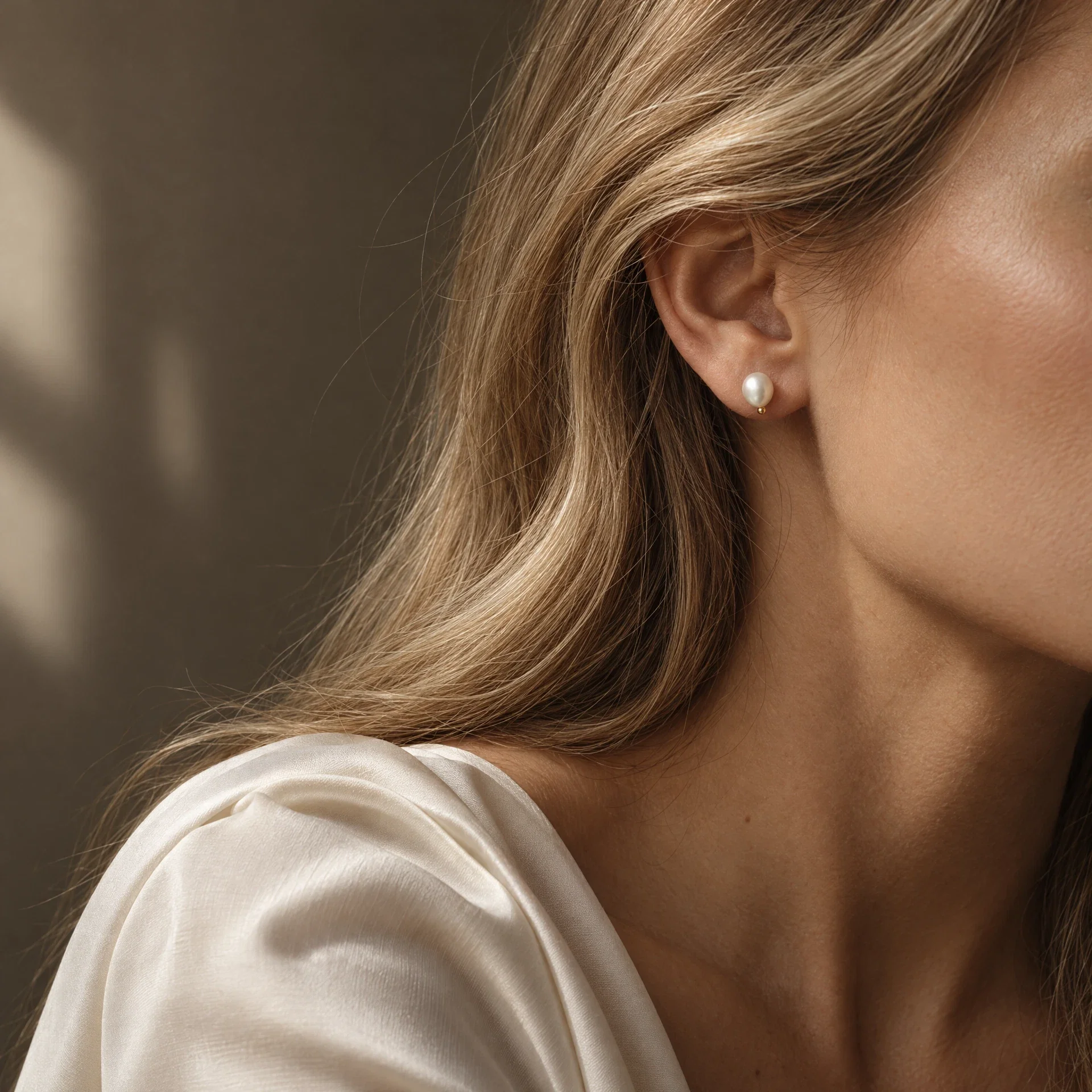
Choosing pearl jewelry starts with looking beyond the familiar white, round strand. A pearl can be softly oval, boldly irregular, warm cream, silvery gray, or dark with shifting overtones. Shape gives a piece its character, but luster, surface condition, setting, and comfort determine how satisfying it will be to wear. The most useful question is not whether a pearl looks traditionally perfect. It is whether its qualities suit your taste, routine, and expectations.
This guide approaches pearl jewelry as a material choice as much as a style choice. A striking pendant may be easy to coordinate yet vulnerable to rough handling; a beautifully matched strand may feel too formal for your wardrobe. Understanding those tradeoffs helps you compare examples with confidence, without treating every surface mark as a flaw or every irregular shape as a bargain.
Understand the Material Before Comparing Beauty
Most pearls encountered in jewelry are cultured: people initiate pearl formation in a mollusk, which then deposits nacre or other pearl material. Natural pearls form without that initiation and are much rarer. Imitation pearls are manufactured lookalikes rather than pearls formed by mollusks. For pearl jewelry, these distinctions matter because appearance alone cannot reliably establish origin, composition, or value.
Freshwater and saltwater describe the environments in which the mollusks live, not a simple quality ranking. Freshwater cultured pearls offer considerable variety in shape and color. Akoya cultured pearls are often associated with round shapes and crisp luster. South Sea cultured pearls commonly offer larger sizes and white, silver, or golden tones, while Tahitian cultured pearls are associated with darker body colors and varied overtones. These are broad tendencies, not guarantees about any individual piece.
When comparing pearl jewelry, ask what type of pearl is being described and whether any color or appearance treatments are disclosed. Dyeing, bleaching, and other treatments can affect appearance; their presence does not automatically make a piece unsuitable. The important points are clear identification and appropriate care instructions. A dark pearl is not necessarily Tahitian, and a highly uniform strand is not necessarily composed of untreated pearls.
Luster is the quality of light reflected from and within the pearl. Look for brightness and the definition of reflections rather than simply a shiny surface. In pearl jewelry with stronger luster, reflected edges often appear clearer; softer luster creates a more diffuse glow. Compare pieces under the same lighting, since spotlights, image editing, and exposure settings can make an ordinary surface appear unusually brilliant.
- Body color: the pearl's predominant color, such as white, cream, or gray.
- Overtone: a secondary translucent hue visible over the body color.
- Surface condition: pits, wrinkles, spots, or other visible characteristics.
- Matching: how consistently pearls relate in size, shape, color, and luster.
Photographs can help narrow your preferences, but they cannot settle every quality question. Before selecting pearl jewelry from images, request confirmation of the material description, dimensions, treatments, and any relevant documentation. Descriptive labels such as “premium” are less useful than specific information; grading language can vary between sellers and should be explained rather than assumed to follow one universal scale.
Choose Shape and Scale With Intention
Round pearls offer visual regularity, especially in matched earrings or a graduated strand. Near-round and oval pearls can provide a similar quiet effect without strict symmetry. Button pearls have a flattened profile that may sit neatly against an earlobe. Drop shapes create direction and movement. Baroque pearl jewelry emphasizes irregular contours, making asymmetry part of the design rather than something to conceal.
Shape alone does not establish quality. An irregular pearl with lively luster may be more visually compelling than a round pearl with a dull surface. Conversely, some baroque forms have projections or deep creases that require closer inspection. Ask whether the contour leaves exposed edges, awkward contact points, or areas that could catch on fabric. The silhouette should work both visually and physically.
Scale changes the experience of pearl jewelry as much as shape does. A small stud can feel restrained and unobtrusive, while a large stud may project farther from the ear and need a supportive backing. A substantial pendant can become a focal point but may swing against a desk or countertop. Consider weight and projection, not just the pearl's diameter in millimeters.
For example, someone who wears tailored shirts might prefer compact button studs that sit close to the ear. Someone who favors plain knitwear might choose a single irregular drop pendant for contrast. Neither example describes a D LOVE product; they illustrate how pearl jewelry can solve different wardrobe needs. If your clothing already has busy patterns, a clear, simple outline often reads more easily than a complicated cluster.
Inspect the Whole Design
A pearl's position can be as important as its individual beauty. In a pair of earrings, slightly different shapes may feel intentional if their proportions and color relate. In a strand, an abrupt shift in luster can be distracting even when the pearls are similar in size. For a pendant, check which surface faces forward and how the piece hangs when worn, not only when laid flat.
Surface characteristics deserve context. Small marks near a drill hole or on the reverse may be less noticeable than a prominent blemish on the outward-facing side. When assessing pearl jewelry, judge the visible result and ask whether any damage affects secure attachment. A growth characteristic is not the same as a crack, chipped drill hole, or loose mounting.
Build a Modern Look Without Sacrificing Practicality
A modern approach need not mean oversized or unconventional. Pearl jewelry can look current through proportion, spacing, and contrast: a single pearl on a clean chain, a short strand beside an open neckline, or simple drops with a crisp jacket. Start with one focal point. Adding several pearl pieces can be beautiful, but coordinated color and scale usually matter more than matching every shape exactly.
Metal color changes the overall impression. Yellow-toned metal can emphasize cream or golden hues; white-toned metal may underline a cool, silvery appearance. These are visual tendencies, not rules. Also ask about the metal itself. Gold-filled is not solid gold, sterling silver contains at least 925 parts silver per thousand, and vermeil descriptions have specific U.S. FTC conditions. A hallmark alone is not proof of authenticity.
For everyday pearl jewelry, examine the parts that do the work: clasp size, earring backs, chain connections, and the way each pearl is secured. Fine components can look delicate but may be difficult to handle. Larger clasps may be easier to operate yet more visible. Rings and bracelets experience frequent contact with surfaces, so pearls in those formats generally require more deliberate handling than earrings.
Layering works best when pieces have room to move without repeatedly striking each other. A pearl pendant rubbing against a metal charm can suffer abrasion, even if the arrangement looks appealing in a photograph. If you enjoy stacked necklaces, choose lengths that separate the focal elements and check the arrangement while sitting and bending. Practical styling involves movement, not just a mirror view.
Use the site's everyday jewelry showcase to think about the broader balance between decoration and wearability, rather than assuming every displayed design suits continuous wear. With pearl jewelry, an office day, a workout, and a swimming session are different conditions. Removing a piece for higher-risk activities is often a better choice than expecting one design to tolerate everything.
For a gift, prioritize the recipient's habits over a supposed essential style. Do they wear earrings, tolerate necklace weight, or prefer minimal accessories? The collection overview can provide visual context for a consultation, but it should not be treated as confirmation of current stock or ordering arrangements. If considering pearl jewelry for someone else, ask D LOVE JEWELRY to confirm current details before making plans.
Care for Pearls and Ask Better Questions
Pearls need gentler treatment than many metal-only pieces. Their surfaces can be affected by abrasion, chemicals, fragrance, chlorine, and heat. Put pearl jewelry on after applying cosmetics and fragrance, allowing products to dry first. Remove it before swimming, cleaning with household chemicals, vigorous exercise, or tasks that expose it to repeated impacts. These precautions reduce avoidable exposure; they do not make a delicate material indestructible.
After wear, gently wipe pearls with a soft, clean cloth. If more cleaning is needed, first check instructions for the complete piece, including stringing, adhesives, and other gemstones. Do not assume soaking is appropriate. Avoid abrasive polishing cloths on pearls, harsh cleaners, steam, and ultrasonic cleaning. The GIA jewelry care guidance offers broader context for matching cleaning methods to materials.
Store pearl jewelry separately from harder gems and metal edges, preferably in a soft-lined compartment or pouch. Avoid prolonged heat and very dry conditions. Do not put a damp strand away in a closed container; let it dry gently at room temperature first. Necklace stringing deserves attention too: stretched spacing, fraying, or a failing clasp are reasons to stop wearing the piece and seek an appropriate assessment.
A Short Consultation Checklist
- What is the pearl type, and are treatments or imitation materials present?
- What are the dimensions, approximate weight, and metal descriptions?
- How are the pearls attached, and what care restrictions apply?
- Can surface characteristics and matching be shown clearly?
- What current arrangements apply to the piece being discussed?
Use the D LOVE JEWELRY contact page to request clarification rather than infer specifications from a photograph. For pearl jewelry, written material and care details are especially useful when the design combines pearls with other delicate components. Ask the brand to confirm current information about any piece or consultation arrangements; the showcase alone does not establish availability, pricing, or policies.
The best pearl jewelry balances visual appeal with realistic wear. Choose the luster you enjoy, the shape that feels intentional, and a scale you can wear comfortably. Then protect that choice with gentle handling and clear information. A softly irregular pearl can be just as satisfying as a precise round one when its design, condition, and care requirements fit your life.