
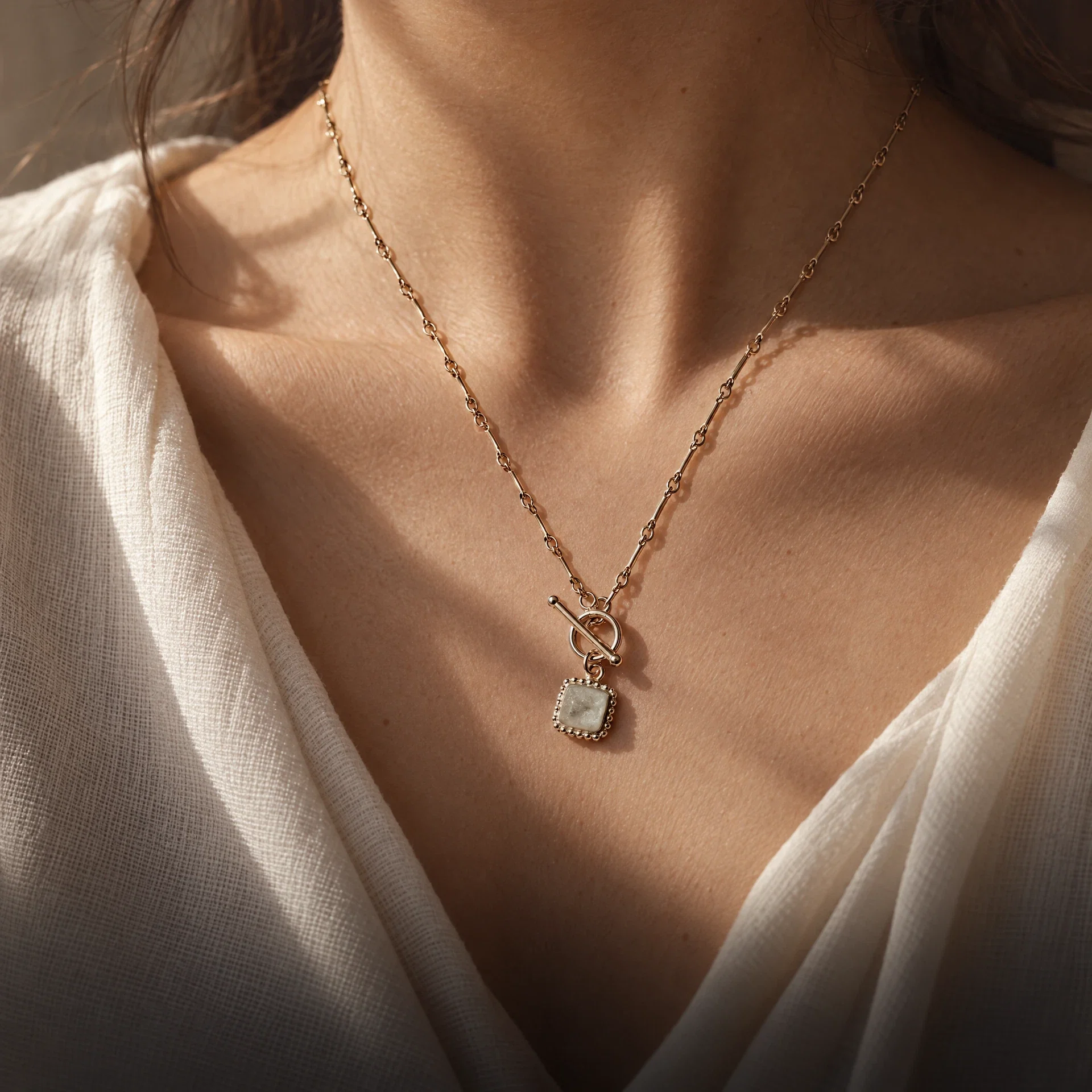
Choosing a cremation necklace is a personal decision, not a test of how much someone meant to you. You might want a piece that quietly belongs with your usual clothes, or one whose symbolism is immediately recognizable. Neither approach is more meaningful. The useful starting point is your own relationship with jewelry: what you actually wear, what feels comfortable against your skin, and how much you want to share with other people.
A cremation necklace may hold a small portion of cremated remains in a chamber, or incorporate memorial material into another element. Designs differ, so do not assume that every pendant works the same way. Before comparing shapes, decide whether you want something wearable, something reserved for particular occasions, or simply a keepsake you can sometimes carry close. There is no obligation to wear it every day, and no deadline for choosing.
Start with your style, not an expected symbol
The easiest way to choose a cremation necklace that feels natural is to examine three pieces you already enjoy wearing. Notice their scale, metal color, chain length, and surface finish. Do you reach for smooth, understated forms, or textured pieces with a visible presence? These observations are more useful than deciding what remembrance jewelry is supposed to look like. A familiar silhouette can make an emotionally significant object easier to include in ordinary life.
For example, someone who usually wears a small silver-colored disc might prefer a plain round pendant over an ornate heart. Someone who loves botanical motifs might feel more connected to a leaf shape. These are examples of design directions, not descriptions of D LOVE JEWELRY products. You can browse the jewelry collections showcase to identify visual preferences, then ask which details are relevant to memorial designs.
Consider how much symbolism you want your cremation necklace to reveal. A recognizable urn or memorial inscription may invite questions. An abstract shape may let you decide when to explain its significance. Neither guarantees privacy: people may still ask about an unusual pendant. Think about whether you would feel comfortable saying, “It is a personal keepsake,” without offering a longer explanation.
Personal meaning does not require engraving. A color, curve, or proportion may connect with a memory just as strongly as a name or date. If lettering matters, ask about the space available, legibility at the actual size, and whether any proposed engraving affects the pendant structure. Ask D LOVE JEWELRY to confirm current personalization details rather than assuming an option shown elsewhere can be reproduced.
Try describing your ideal cremation necklace in one sentence: “A small, matte pendant I can wear under a shirt,” or “A visible, sculptural piece for family occasions.” That sentence becomes a filter. When a beautiful design conflicts with your stated needs, you can recognize the tradeoff instead of feeling that you ought to choose it.
Finally, separate your preferences from other people's expectations. Matching pieces may appeal to some families, but different styles can honor the same person. Your cremation necklace does not need to resemble anyone else's, and choosing not to wear memorial jewelry is equally valid.
Understand the construction and material tradeoffs
Before committing to a cremation necklace, ask how the memorial material is held and what parts can be accessed. A chamber pendant raises questions about its opening and closure; an incorporated memorial element raises different questions about its composition and care. Neither format should be judged from appearance alone. Request a clear explanation of the particular design, including its limitations, before agreeing to entrust anything irreplaceable.
Useful questions concern the complete object, not just its decorative front. Ask what the pendant body, chain, clasp, connecting rings, and any coating are made from. “Gold-colored” describes appearance, not a specific composition. Gold-filled is not solid gold. Sterling silver is at least 925 parts per thousand silver, while vermeil descriptions have specific U.S. Federal Trade Commission conditions. A hallmark can be informative, but is not proof of authenticity by itself.
The right material for a cremation necklace depends partly on your tolerance for maintenance and visible change. Silver can tarnish and may need appropriate cleaning. Plated surfaces can wear with use, although the rate depends on construction and exposure. Solid precious-metal pieces can still scratch or require maintenance. If future refinishing or repair matters to you, ask whether it is possible for that exact design rather than assuming it is.
For organic or resin-based elements, request care guidance specific to the finished piece. Do not assume that a clear surface is glass, that a sealed appearance means waterproofing, or that a metal exterior protects every internal component. If you have experienced reactions to jewelry before, ask for detailed material information. No appearance or general material label can guarantee that a piece will suit your skin.
With a cremation necklace, emotional value can make repair questions particularly important. Ask what would happen if the chain broke, the closure loosened, or the pendant needed attention. Can the chain be replaced independently? Would repair require access to the memorial element? Ask D LOVE JEWELRY to confirm any current repair arrangements or limitations in writing; do not infer them from general jewelry practices.
The cremation keepsake information page can provide a starting point for understanding the category. Use it alongside questions about the individual design. A cremation necklace should come with enough clear information for you to understand what you are choosing, including what remains uncertain.
Check comfort against the way you actually live
A cremation necklace can look balanced in a photograph yet feel too heavy, too long, or too prominent when worn. Ask for pendant dimensions and weight, chain length, and the size of the opening that connects pendant and chain. Measurements are more useful than words such as “delicate” or “substantial.” If possible, compare them with a necklace you own, while remembering that a similar size does not guarantee the same feel.
Use an existing chain to test where you prefer a pendant to sit. A shorter length may keep it visible above a neckline but feel crowded beside another necklace. A longer chain can tuck beneath clothing, yet may swing when you lean forward. For example, someone working at a desk may prioritize a pendant that does not knock against the tabletop; someone wearing scarves may notice snagging more.
Pay attention to the less visible features of a cremation necklace: the back, edges, connecting loop, and clasp. Raised details may catch knitwear or hair. A clasp that is difficult for your hands to operate can make an otherwise appealing necklace frustrating. Ask whether an alternative chain or clasp is appropriate for the pendant, and have the compatibility confirmed rather than changing components on assumption.
Daily wear is not a requirement. If your work involves machinery, protective equipment, or rules about jewelry, follow the relevant safety requirements. Exercise, sleep, bathing, and swimming also bring exposure or snagging risks. A cremation necklace may fit your life best as an occasional piece, worn during quiet mornings or family gatherings rather than through every activity.
Layering deserves a practical check too. Pendants and chains can rub against each other, while several meaningful pieces may feel visually or physically crowded. Start with the memorial pendant alone, then consider whether another chain improves comfort or merely adds weight. The everyday jewelry guide offers a useful context for thinking about wearable proportions and ordinary routines.
Imagine three realistic situations: getting dressed on a rushed morning, spending several hours seated, and removing jewelry at the end of the day. Where would your cremation necklace sit, and where would you put it afterward? A choice that works through these small moments may suit you better than one selected only for its display photograph.
Make room for questions, care, and a slower decision
Before arranging a cremation necklace, establish who is comfortable contributing memorial material and whether there are family, cultural, or local considerations. Do not assume that possession of remains settles every question about their use. Obtain written instructions from the intended recipient and any applicable local information before sending anything. Avoid relying on generic advice about quantities, preparation, containers, or mailing procedures.
A brief written checklist can keep the conversation manageable. You do not have to resolve everything at once, but the important uncertainties should be addressed before you proceed.
- What is the exact material and construction of the pendant and chain?
- How is the memorial material held, and what limitations should I understand?
- What written handling instructions apply before anything is provided?
- What care, closure checks, and repair considerations apply to this design?
- Which current customization details, costs, and arrangements need confirmation?
Care for a cremation necklace should follow the guidance for its most sensitive component. Chemicals, fragrance, chlorine, heat, and unsuitable ultrasonic cleaning can harm some jewelry, delicate gems, pearls, and organic or resin-based pieces. Do not assume a method suitable for plain metal is safe for a memorial pendant. Ask before immersing it, polishing around a closure, or using commercial cleaning solutions.
When the piece is not being worn, choose a consistent resting place where it is protected from rubbing against other jewelry. Keep any written care information with your records. If you notice a loose connection, altered closure, or damaged surface, stop wearing it and seek design-specific advice. Avoid improvised repairs when access to the memorial material could be affected.
If you are considering a cremation necklace for someone else, ask whether they want wearable remembrance jewelry before discussing style. A gentle conversation leaves room for an occasional keepsake, a different form of remembrance, or no jewelry at all. Surprise gifting can remove decisions that the wearer may reasonably want to make themselves.
When you are ready, use the D LOVE JEWELRY consultation contact page to share your preferences and ask for current details. Describe your preferred scale, finish, wearing habits, and privacy needs. The most suitable cremation necklace is not necessarily the most elaborate one; it is the piece whose meaning, practical demands, and appearance feel right to you.